
Cases of Universal Design: Lessons for Thai public spaces
By Maya-Gninê Diourté (LinkedIn), Research Intern 2025
15 December 2025
This report is produced by NACSA - Nature And City Scape Analytics in contribution to the research, “Universal Design: A Decade’s Review of Experience and Literature (2015-2024)”, funded by the Thai Health Promotion Foundation under a larger research umbrella by Chulalongkorn University, Social Research Institute, in 2025. For the PDF version of the report, please visit this link.
Introduction
This case study report is inspired by and contributes to NACSA’s research, "Universal Design: A Decade’s Review of Experience and Literature (2015-2024),” funded by the Thai Health Promotion Foundation (THPF) in 2025. The research examines the development and implementation of universal design in public spaces in Thailand, with the aim of understanding the gaps in public awareness, knowledge advancement, and implementation within the THPF’s network of local actors and across Thailand as a whole. The research highlights the current state of universal design in Thailand and explores possibilities for enhancing public spaces for all, adhering to the principles of universal design, while considering individuals with various disabilities and Thailand's aging population. The research combines 3 methodologies: 1) a systematic literature review of universal design research in Thailand, 2) semi-structured interviews with key stakeholders within the THPF network, and 3) case study reviews of 3 model countries, including Japan, France, and Sweden.
“Cases of universal design: Lessons for Thai public spaces” contributes to the research primarily on the three case studies of universal design policy and implementation development in France, Japan, and Sweden. This report aims to provide a deeper understanding of universal design and policy interpretation in other contexts, offering lessons and suggestions for Thailand to move forward. The selection of these three case studies aims to explore various issues in diverse contexts. France is focusing on transforming old public spaces and government services for people with disabilities, utilizing the 2024 Olympics as a key promotional and funding portal for much of its transformation. Japan puts a great deal of effort into adapting existing facilities to meet the needs of all, especially in the context of an extreme aging society. Lastly, Sweden serves as a notable showcase for the evolution of the process in a context where universal design has been implemented for a considerable time, as well as its prospects for further development.
This work presents both a descriptive report of existing facilities and an interpretation of Universal Design in Thailand, aiming to suggest avenues for evolution to guide the realization of policy.
Principles of UD
The 7 Principles of Universal Design (UD) were developed in 1997 by a working group of architects, product designers, engineers, and environmental design researchers, led by the late Ronald Mace at North Carolina State University (The 7 Principles of Universal Design, n.d.). These principles can serve as design guidelines, adaptable for use in policymaking, building design, service design, and even digital design. While each country has its own interpretation and terminology of universal design, these principles can still be found integrated into policies and implementations to promote universal design for all across the three cases. Furthermore, these principles can also serve as guiding tools in Thailand to anticipate the needs of an aging population, as well as to bridge the needs of people with disabilities and those of the general population.
Principle 1: Equitable use — The design is useful and marketable to people with diverse abilities.
Principle 2: Flexibility in use — The design accommodates a wide range of individual preferences and abilities.
Principle 3: Simple and intuitive use — The design is easy to use and understand, regardless of the user's experience, knowledge, language skills, or current level of concentration.
Principle 4: Perceptible information — The design communicates necessary information effectively to the user, regardless of ambient conditions or the user's sensory abilities.
Principle 5: Tolerance for error — The design minimizes hazards and the adverse consequences of accidental or unintended actions.
Principle 6: Low physical effort — The design can be used efficiently and comfortably, with minimal fatigue.
Principle 7: Size and space for approach and use — Appropriate size and space are provided for approach, reach, manipulation, and use regardless of the user's body size, posture, or mobility.
Challenges of UD
Semantic matters: Multiple definitions and intentions
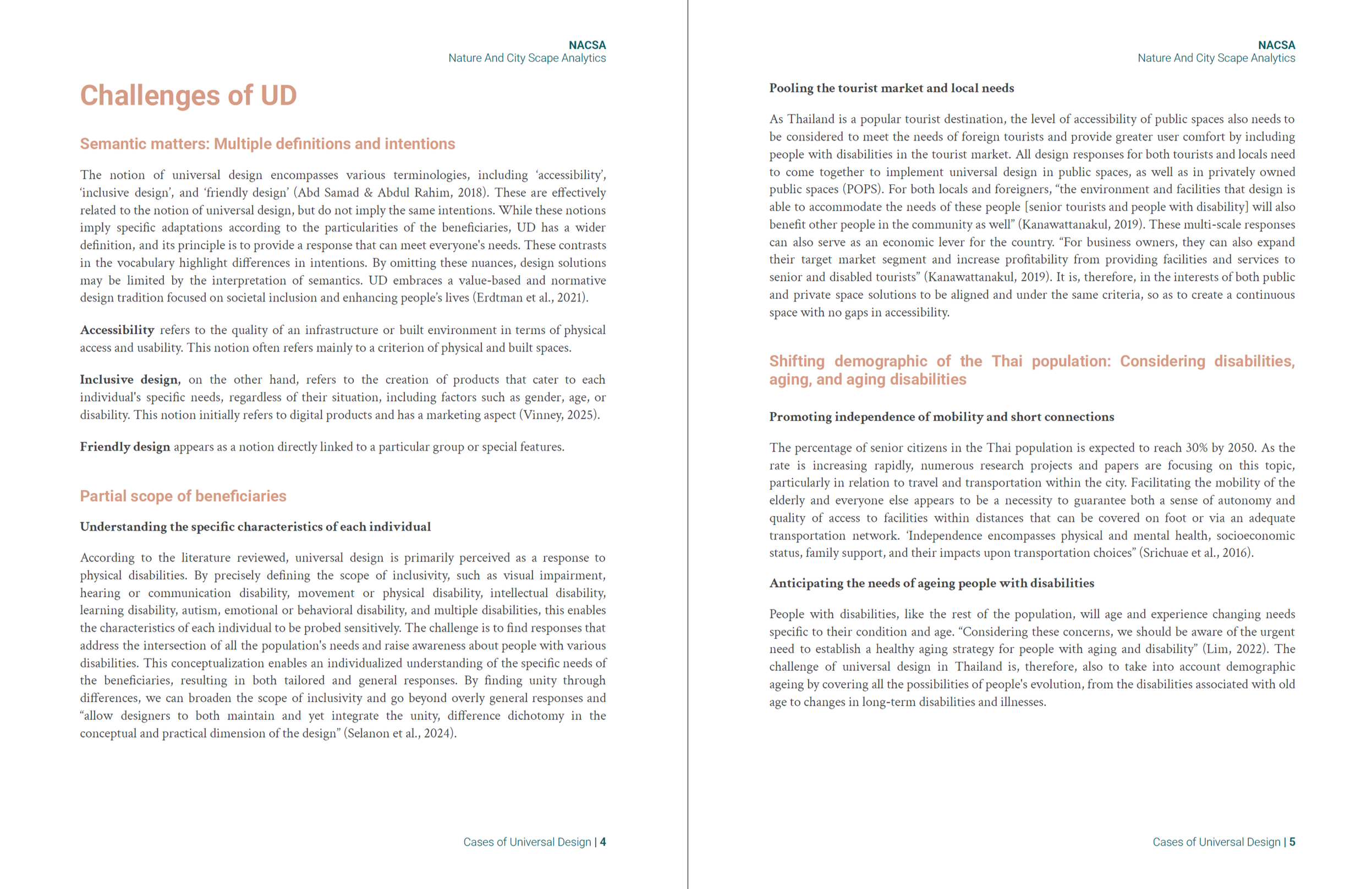
The notion of universal design encompasses various terminologies, including ‘accessibility’, ‘inclusive design’, and ‘friendly design’ (Abd Samad & Abdul Rahim, 2018). These are effectively related to the notion of universal design, but do not imply the same intentions. While these notions imply specific adaptations according to the particularities of the beneficiaries, UD has a wider definition, and its principle is to provide a response that can meet everyone's needs. These contrasts in the vocabulary highlight differences in intentions. By omitting these nuances, design solutions may be limited by the interpretation of semantics. UD embraces a value-based and normative design tradition focused on societal inclusion and enhancing people’s lives (Erdtman et al., 2021).
Accessibility refers to the quality of an infrastructure or built environment in terms of physical access and usability. This notion often refers mainly to a criterion of physical and built spaces.
Inclusive design, on the other hand, refers to the creation of products that cater to each individual's specific needs, regardless of their situation, including factors such as gender, age, or disability. This notion initially refers to digital products and has a marketing aspect (Vinney, 2025).
Friendly design appears as a notion directly linked to a particular group or special features.
Partial scope of beneficiaries
Understanding the specific characteristics of each individual
According to the literature reviewed, universal design is primarily perceived as a response to physical disabilities. By precisely defining the scope of inclusivity, such as visual impairment, hearing or communication disability, movement or physical disability, intellectual disability, learning disability, autism, emotional or behavioral disability, and multiple disabilities, this enables the characteristics of each individual to be probed sensitively. The challenge is to find responses that address the intersection of all the population's needs and raise awareness about people with various disabilities. This conceptualization enables an individualized understanding of the specific needs of the beneficiaries, resulting in both tailored and general responses. By finding unity through differences, we can broaden the scope of inclusivity and go beyond overly general responses and “allow designers to both maintain and yet integrate the unity, difference dichotomy in the conceptual and practical dimension of the design” (Selanon et al., 2024).
Pooling the tourist market and local needs
As Thailand is a popular tourist destination, the level of accessibility of public spaces also needs to be considered to meet the needs of foreign tourists and provide greater user comfort by including people with disabilities in the tourist market. All design responses for both tourists and locals need to come together to implement universal design in public spaces, as well as in privately owned public spaces (POPS). For both locals and foreigners, “the environment and facilities that design is able to accommodate the needs of these people [senior tourists and people with disability] will also benefit other people in the community as well” (Kanawattanakul, 2019). These multi-scale responses can also serve as an economic lever for the country. “For business owners, they can also expand their target market segment and increase profitability from providing facilities and services to senior and disabled tourists” (Kanawattanakul, 2019). It is, therefore, in the interests of both public and private space solutions to be aligned and under the same criteria, so as to create a continuous space with no gaps in accessibility.
Shifting demographic of the Thai population: Considering disabilities, aging, and aging disabilities
Promoting independence of mobility and short connections
The percentage of senior citizens in the Thai population is expected to reach 30% by 2050. As the rate is increasing rapidly, numerous research projects and papers are focusing on this topic, particularly in relation to travel and transportation within the city. Facilitating the mobility of the elderly and everyone else appears to be a necessity to guarantee both a sense of autonomy and quality of access to facilities within distances that can be covered on foot or via an adequate transportation network. ‘Independence encompasses physical and mental health, socioeconomic status, family support, and their impacts upon transportation choices” (Srichuae et al., 2016).
Anticipating the needs of ageing people with disabilities
People with disabilities, like the rest of the population, will age and experience changing needs specific to their condition and age. “Considering these concerns, we should be aware of the urgent need to establish a healthy aging strategy for people with aging and disability” (Lim, 2022). The challenge of universal design in Thailand is, therefore, also to take into account demographic ageing by covering all the possibilities of people's evolution, from the disabilities associated with old age to changes in long-term disabilities and illnesses.
From different public spaces to different perceptions
Include all those involved in daily public infrastructures
Public spaces are everyone's business, from the people who use and work in them to those who design them. Through collaborative initiatives and decision-making, the built environment can respond as precisely as possible to the needs of all individuals by integrating theory, practice, and everyday use. “All stakeholders involved with the hospital, including the designer, executives, staff, general users, and users across all levels of physical impairments, should have an opportunity to participate in the design process and be given equal importance” (Phaholthep et al., 2021). The built environment is therefore suggested as a space for joint decision-making where the active and joint participation of users and designers would provide a better understanding of the reality of the spaces in which they live.
Green spaces as experimental fields: places of interaction
Among the places studied, green spaces appear to be areas that facilitate the creation of universally designed sub-spaces. These spaces, which are open to all, offer the possibility of being both places of exchange and of stratifying space in a variety of ways that can cater for everyone.‘The layout of the areas and the presence of green spaces, sensorial features, and passive and active spaces positively contribute to creating diverse occasions for improving the social engagement of the area” (Selanon et al., 2024). This approach appears to be a way of integrating marginalized groups into practices (e.g., sports, outdoor activities) that aim to explore different lifestyle possibilities.
Case studies: UD from three perspectives
Exploring universal design across various societies enables a richer understanding of practices shaped by diverse contexts in Europe and Asia, allowing for meaningful insights into their successes and shortcomings.
Transformation—France
Extending the public space to the online sphere with wide accessibility to communication and service.
The case of France illustrates the importance placed on making information accessible to all. Through a range of government sites, a large resource of guidelines is freely accessible, aimed at both professionals and users. One of these key initiatives is the online platform ‘AccessLibre’, which lists the level of accessibility of all public spaces and shares this information as widely as possible online (AccessLibre, La Plateforme Collaborative de l’accessibilité, n.d.). This government start-up, launched by the French Ministry of Ecological Transition, aims to create a collaborative digital service that guides and includes all users, while giving visibility to universally designed public spaces and privately owned public spaces (e.g., restaurants, museums, city halls, etc.).
Developing tools for sensory, psychological, and mental impairments.
Other important actions involve the inclusion of mental and psychological disabilities in various ways. Among the guidelines shared, the FALC method is a principle applied in public speeches and posters. FALC method is “a content design method created in 2009 under the impetus of the Inclusion Europe association” (info.gouv, n.d.). The aim of this method is to employ inclusive semantics and language that is easy for everyone to understand, particularly by promoting the use of simple vocabulary and concise sentences, without the use of metaphors. This method is particularly inclusive for people with neurodevelopmental disorders such as autism spectrum disorder. In addition, a proposition of law was introduced in September 2019 to introduce ‘silent hours’ in French supermarkets, requiring interruption-free sounds in the store and dimmed lights for an hour per day during opening hours. This suggestion, which was unfortunately not successful in its pilot phase, explores a way to transform daily-use public spaces into flexible areas that cater to individuals' varying sensitivities.
The case of Paris—building a continuity in the built environment: A pedestrian-oriented design
The Parisian strategy of pedestrian planning (Un «plan piéton» pour piétonniser massivement Paris, n.d.) directly integrates universal design principles (named universal accessibility) to massively upgrade access and comfort to the streets by giving priority to ground-floor services that are directly connected to the streets and creating unobstructed views to help people navigate easily. The challenge is also to ensure that streets and transport systems are equally accessible, particularly by ensuring sufficient length of the bus stop for users to go in and out of the bus, adapting the height of sidewalks to the bus ground height, and even relocating or removing street furniture to not encroach on the mobility of all. This policy aims to create an uninterrupted space, also limiting gaps between one place and another, thereby achieving door-to-door continuity (Apur, 2020).
Adaptation—Japan
As the Japanese lifespan and population ratio of individuals aged 65 and above increase (Kose, 2021), Japan faces a pressing need to refurbish existing facilities to accommodate the evolving demographic. They also need to adapt their public policies and attitudes towards disabilities and age-related disabilities.
Modifying the existing design environment—enhancing local initiatives
Research into the case of Japan highlights the importance of evaluating and adapting existing solutions. Through local ordinance schemes, local authorities can require their own standards of accessibility performance and enable them to innovate in terms of universally designed development. Initially, the scheme was intended to take earthquake measures and was later expanded to integrate the needs of people with disabilities in buildings and public spaces. This axis of policy allows for new initiatives and re-examination of the existing spaces to find adjustments on existing structures (Dobashi & Ohmori, 2018). As an example, we can cite railways in Tokyo showing that rearrangement of the existing infrastructure can allow a smoother guidance in the built space where “different trains travelling in the same direction but to different destinations use the same platform, letting people change trains easily [...]’ (Kimura, 2006).
Implementing service design in the economic market as a convincing approach
Through economic initiatives, the Japanese market has developed a range of products and services based on universal design principles. Kyoyohin, whose model of everyday life products and goods (Herwig, 2012), could be extended to another scale of design for the daily environment. Moreover, the standardization of UD principles in the product markets was a starting point for further policy. An examination of Japanese accomplishments reveals that they are most effective when introduced into the market with economic incentives. Perhaps the best policy is to combine them with legal enforcement (Kose, 2011). This is an opportunity to browse a shared approach between policies and private players, which will eventually be extended to other spheres of public products and spaces.
Process—Sweden
The case of Sweden opens up our thinking towards a country where universal design is a long-term development strategy implemented from the very beginning of policy-making. In this case, the notion of UD is rather “a guiding principle from the beginning” (Erdtman et al., 2021). In the case of Sweden, this allows some of these principles to be questioned and evolve. They believe that UD must evolve in response to its context and serve as a starting point for innovation.
Co-creation: Allowing a flexible practice with a collaborative approach
The Swedish case suggests a more collaborative approach to the making of the practice and process. Beyond policy, it implies a realistic need-based process where users' experiences and practitioners share their perspectives to develop realistic designs in a multidisciplinary approach. “[I]ntersectional collaboration involves different groups and perspectives in cross-boundary processes, not in separate tracks” (Erdtman, 2024). Moreover, the concept of ‘co-creation’ implies that solution and discussion are the starting point of innovation and solution-finding, not a confrontation. That highlights, as well, a notion of UD’s strategy emerging from experience rather than theoretical concepts.
Beyond categories: Relying on the personal experience of each individual
Swedish researchers are exploring another dimension of universal design practice, where responses, whether in the built environment or services, must address the individual beyond their disabilities. This implies that each individual cannot be understood solely in terms of their impairment, and that other factors must be taken into account. This means, for example, that a group of people who share the same disability do not necessarily share the same needs, as other factors such as age, gender, or multiple disabilities change their personal experience. “This means that the experiences of disabled people should not be regarded as bound to specific impairments. Their user stories should not be categorised according to impairments” (Erdtman, 2024). This interpretation suggests that the scope of inclusivity should be broadened to include a more personal understanding and less normative responses. “The concept and practice of UD must be continually updated and contextualized to offer relevant and practical potential” (Erdtman et al., 2022).
Lessons for Thailand
Communicating clear intentions of UD
Developing and sharing universal design goals in the public sphere appears to be essential for maintaining a broad scope of inclusivity. For example, setting up a centralized online platform accessible to all and gathering guiding information for users, personal testimonies from beneficiaries, and guidelines for practitioners can help establish a common and accessible source of data to initiate and perpetuate the integration of UD into public space development practices.
Supporting professional capacities to improve social sensitivity
In the continuity of the previous point, through platforms that are only dedicated to professionals (e.g, architects, restaurant owners, hospital staff, etc.), it could not only allow practitioners to understand how to integrate UD principles in their practice it could also give them visibility and, from that, encourage them to pursue a design for all model. Assisting professionals also means giving them the opportunity to hear beneficiaries' voices and better understand them through research-based initiatives or a structured and rewarding policy, such as government certifications.
Reaching the digital public space
These suggestions rely on considering the digital space as a public space in its own right. Considering the ubiquity of online interactions, the accessibility of information, and the numerous services emerging from the digital space. Thus, it appears important to both develop online tools to share UD knowledge and ensure ease of use.
Building a continuity between local needs and tourist interests
As a highly touristic country, Thailand appears to have the opportunity to utilize its tourism market as a point of innovation for UD implementation. Meeting universal and international accessibility criteria can provide momentum that benefits both local users and tourists, creating continuity between built spaces and reducing design gaps.
Reference
Abd Samad, N. A., & Abdul Rahim, A. (2018). A review of universal design and accessibility legislation in implementation strategies among Asian Countries. Retrieved July 2, 2025, from https://www.researchgate.net/publication/327231407_A_REVIEW_OF_UNIVERSAL_DESIGN_AND_ACCESSIBILITY_LEGISLATION_IN_IMPLEMENTATION_STRATEGIES_AMONG_ASIAN_COUNTRIES
Acceslibre, la plateforme collaborative de l’accessibilité. (n.d.). Retrieved June 9, 2025, from https://acceslibre.beta.gouv.fr/
Apur. (2020, March 17). Espaces publics inclusifs, un héritage des Jeux de Paris 2024, vers une accessibilité pour tous de Paris. Apur. Retrieved July 2, 2025, from https://www.apur.org/fr/nos-travaux/espaces-publics-inclusifs-un-heritage-jeux-paris-2024-vers-une-accessibilite-paris
Dobashi, Y., & Ohmori, N. (2018). Re-Examining the Creativity of Universal Design Initiatives in Public Spaces in Japan. Studies in Health Technology and Informatics, 256, 279–289.
Erdtman, E. (2024). Universal Design as Co-Creation: Experiences and Visions from Urban Development Projects in Sweden. Studies in Health Technology and Informatics, 320, 98–105. https://doi.org/10.3233/SHTI240989
Erdtman, E., Rassmus-Gröhn, K., & Hedvall, P.-O. (2021). Universal Design as Guiding, Striving and Unifying: A Qualitative Study about how Universal Design is Understood, Practised and Realised in Contemporary Sweden. Scandinavian Journal of Disability Research, 23(1). https://doi.org/10.16993/sjdr.770
Erdtman, E., Rassmus-Gröhn, K., & Hedvall, P.-O. (2022). Let us move beyond word battles and separatism: Strategies and concerns regarding universal design in Sweden. Equality, Diversity and Inclusion: An International Journal, 41(9), 15–29. https://doi.org/10.1108/EDI-04-2021-0108
Herwig, O. (2012). Universal Design: Solutions for a barrier-free living. Walter de Gruyter.
info.gouv. (n.d.). Accessibilité des documents: Cap sur l’information pour tous - L’accessibilité : un enjeu universel. Retrieved July 2, 2025, from https://www.info.gouv.fr/accessibilite/accessibilite-des-documents-cap-sur-l-information-pour-tous
Kanawattanakul, T. (2019). A model of universal design for senior tourists: A case study of North to Central Pattaya Beach Road areas [Master of Business Administration, Silpakorn University]. DSpace. http://ithesis-ir.su.ac.th/dspace/handle/123456789/2451
Kimura, K. (2006). Universal design for railways—Accessibility for everyone. Japan Railway & Transport Review, 45. https://trid.trb.org/View/796746
Kose, S. (2011). The impact of aging Japanese accessibility standards. In Universal design handbook (2nd ed, pp. 116–124). McGraw-Hill.
Kose, S. (2021). From Barrier-Free to Universal/Inclusive Design: How Far Have We Progressed During These 60 Years in Japan? Studies in Health Technology and Informatics, 282, 32–40. https://doi.org/10.3233/SHTI210382
Lim, J.-Y. (2022). Aging with Disability: What Should We Pay Attention to? Annals of Geriatric Medicine and Research, 26(2), 61–62. https://doi.org/10.4235/agmr.22.0068
Phaholthep, C., Bunyasakseri, T., & Phaholthep, P. (2021). The Investigation of Physical Design, Executives’ Attitude and Policy Towards Service Efficiency Based on Universal Design Principles; A Case Study of Naresuan University Hospital. Studies in Health Technology and Informatics, Volume 282: Universal Design 2021: From Special to Mainstream Solutions(Studies in Health Technology and Informatics), 273–287. PubMed. https://doi.org/10.3233/SHTI210404
Selanon, P., Puggioni, F., & Dejnirattisai, S. (2024). An Inclusive Park Design Based on a Research Process: A Case Study of Thammasat Water Sport Center, Pathum Thani, Thailand. Buildings, 14(6), 1669. MDPI. https://doi.org/10.3390/buildings14061669
Srichuae, S., Nitivattananon, V., & Perera, R. (2016). Aging society in Bangkok and the factors affecting mobility of elderly in urban public spaces and transportation facilities. IATSS Research, 40(1), 26–34. https://doi.org/10.1016/j.iatssr.2015.12.004
The 7 Principles of Universal Design. (n.d.). Centre for Excellence in Universal Design. Retrieved July 4, 2025, from https://universaldesign.ie/about-universal-design/the-7-principles
Un « plan piéton » pour piétonniser massivement Paris. (n.d.). Retrieved June 9, 2025, from https://www.paris.fr/pages/un-plan-parisien-pour-donner-la-priorite-aux-pietons-25499
Vinney, C. (2025, April 30). Accessible design vs. Inclusive design vs. Universal design [UX Design Institute]. Retrieved July 2, 2025, from https://www.uxdesigninstitute.com/blog/accessible_design-inclusive_design/